Showing posts with label EM66. Show all posts

Thursday, 16 March 2023

2023 Topic 03: Focus on Seth Apter {by Renata Peley} with Seth Apter Products


Hi everyone, it’s Peley Renata with you today and in this blog, you can see me struggle, you can see me squirm as I do a project way out of my comfort zone. As perhaps some of you know, I am mostly comfortable with doing art journal pages, with little to no dimension. And now I challenged myself to make a very dimensional and somewhat abstract 3D project in combination with some fun stamps designed by Seth Apter.


Of course, it wasn’t pain and suffering. You know, a bit of a personal challenge builds character. And if I’m going to be completely honest, I did enjoy this project and now that I let go of my fear of this type of 3D bulky and layered projects, I’m probably going to make them again from time to time.

Anyway, as the quarterly topic is “Tracks”, I decided to make my project in a manner of a riddle, and you have to follow certain tracks and clues to find my secret message. This idea got me quite immersed and had lots of fun figuring out how it would work.


I guess a lot of you who are PaperArtsy fans are also familiar with the work of Seth Apter. He designed quite a selection of stamps and colors for them. And even more, he has a unique and recognizable style, and my task was to make a project in that particular style. Of course, that doesn’t mean to simply copy his work, but rather to be inspired by it and add some personal touches. And in truth, being inspired by his work wasn’t that hard.

To get a better picture of Seth Apter’s work, I went for a bit of research on his web page. If you visit his page and click on the “Artwork”, you can get a clear image of his art approach. Now what’s left to do is to try to incorporate his style with my own, together with the PaperArtsy quarterly topic.

The second step after the research was to go and see what kind of papers and items I could gather up from my stash, and start formulating a strategy to approach my somewhat developing project idea.


Now, don’t get intimidated by my selection of items. You most certainly don’t need all these. Anyway, at the end I won’t use even half of them. These were just gathered up to get my imagination flowing.

Over the years I have become a passionate collector of little metal charms. And I always think: “Oh this one looks versatile/pretty” or “I’m sure I’m going to need this one sooner or later”, but the truth is, I almost never use them, so I made a promise to myself to use a few of them in this project.


Have you ever heard of the infinite calendar? It’s basically what its name says, a calendar which you move manually every day in order to keep track of the date and you can use it every year over and over again. If you are curious, you can just look it up on Pinterest and there you can find several versions of this calendar. I was inspired by the round version, to make my first “clue” piece. The starting point for this element was the stamp set from Seth Apter (ESA31).


If you take a look at this stamp set, it has this gorgeous round design with several circles with letters. So, what I did is to take a heavy weight paper (300gsm) and applied a mix of PaperArtsy Fresco Finish Acrylic Paints: Buff (FF96) and Squid Ink (FF56). When the paint was dry, I stamped the previously mentioned stamp three times and heat embossed it with black embossing powder.


After cutting out three circles of my stamped images (each one smaller than the previous one), comes the tricky part. Now, I’ll let you on a little secret, I genuinely dislike designing precise and working 3D elements, so I asked my husband for a little help. What I needed is to craft an element which will hold my circles together and have an opening through which we can see one letter from each of the three circles. On the image below you can see what we came up with and what my husband drew for me. 😊


The next step was to cut out the drawn shape and connect the elements.

By the way, you know how foam tapes are sticky on the bottom, but on the top, they have that smooth paper, which you are supposed to peel off? Well, in order to prevent my circles from sticking to each other and to spin more smoothly, between each of them I put a piece of a foam tape, without removing the protective layer from it. Meaning, it sticks to the lower circle, but it leaves the upper part non-adhesive and smooth. That provided the buffer area for a smooth rotation of the circles.


With that, all the elements were ready, so I just pierced a hole in the middle of the circles and connected them all with a metal braid. Here you can see the finished result.


This rotating circle is supposed to be one of my focal elements. But now I wanted to make another important piece. A secret box with a message. My box was actually an empty matchbox, but of course first I had to paint it. For this I decided to use once again PaperArtsy Fresco Finish Acrylic Paint Squid Ink, but also Black Dress (FF19).

At this point my box looked rather plain so I decided to embellish it a bit with one of the mini stamps designed by Seth Apter (EM55). I just stamped the image with the archival ink, without caring about getting a perfect impression. Then once again I just had to add another small detail and this was a tiny bit of the PaperArtsy Fresco Finish Acrylic Paint White Fire (FF121). And when I say “a tiny bit” I really mean a tiny bit as I just put a very small amount of paint on a toothpick and rubbed it over the surface of the box. It is a very subtle detail and it can be seen just under certain light, but I think it really looks nice and it gives it a more metallic look. Oh, and I also used White Fire on the black piece of my rotating circle.


In order to make the box open more easily I attached to it a tiny metal clip on one side. Now for the content of the box I had a tea-dyed notebook paper and I stamped another one of the Seth Apter mini stamps (EM65) on it. This was to serve as my “secret” message. And just for the fun of it, I also put a small metal key next to it.


With these two elements crafted, it was time to start thinking of a composition and another round of checking for items that I could incorporate in my project.


I must admit, at this point I was very confused with how to proceed. I started to doubt the size of my originally planned substrate. I also felt that all those goodies that you saw me assemble at start aren’t appropriate, or just not enough. It was time for me to take a break and wait for a new day to start with a fresh brain. And guess what? The next day I sit at my crafting table and did some fumbling and tumbling…and again came up with nothing. It was time for some more research. I went scouring Pinterest, my fellow crafters Instagram accounts and of course Seth Apter’s web page and finally some ideas started to form.

I realized that I wasn’t troubled just by the size of my substrate, but also by the oval shape of it so it was time to consider some other options.

Years ago, my husband was into some furniture-making, so we still had some wood planks of various sizes stashed around. There I found some smaller boards that finally helped me to start going again.

I took a few narrow boards, but I wanted to alter their color a bit. As I decided to stick to my original color scheme, so again I took PaperArtsy Fresco Finish Acrylic Paints Squid Ink and Little Black Dress. But I didn’t want to just cover whole boards, instead I put the paint only on the edges of the panels, so it would look something almost like burnt wood.


Now the question was how to connect the wood planks. The idea was to use a furniture stapler gun as it would contribute to the whole grunge vibe, but apparently, I am one of those people who can’t find stuff in their own home, so I had to find another solution.

First, I thought just to glue the boards to each other, and it was not a bad solution, but I wanted something a bit more special. What I did was to yet again ask my hubby for some help. He drilled 16 small holes in my planks so that I could connect them using a bit sturdier thread. For each connecting point we made four holes so that I could connect the wood in an “X” shape, as you can see on the image below.


When connecting the planks, you can decide how you want to align them. I chose to make them just a little bit off, but I did pay attention to use one plank that was a bit shorter than the others, so that in that place I could put my matchbox with the message. I glued one side of the matchbox to the lower side of my shortest wood board.


At this point I decided to build up one more element before I start concentrating on my layout. On the stamp set PaperArtsy Seth Apter ESA31, you can see those two stamps with vertically spelled words and since they very much appealed to me, I decided to use one of them. When I was searching for my possible substrate, I also found these mini 5-10cm narrow wood panels which were just the ideal size for stamping my words. I prepped the panel with PaperArtsy Fresco Finish Acrylic Paints Buff (FF96) and Squid Ink (FF56). When the paint was dry, I stamped and heat embossed the word ‘document’ with black embossing powder. And here is how it turned out.

Now with my substrate and a few important elements finally complete, it was time to start thinking about the composition. And guess what? This turned out to be the most challenging part of my project yet. I had two considerations. First, I really liked the look of my wooden boards and wanted to be sure they are not completely covered with the elements that I planned to layer on top. Second, I didn’t want just to pile my elements randomly, I wanted to give it all some meaning and sense.


I know that making a layout shouldn’t belong to the twists and turns section of the blog, but if we are being honest, for me making this layout was all about twists and turns of actions. I think I made about ten possible layouts over several days until I finally found one that I was happy with.

The idea was to have a few different types of papers layered on top of each other, with a random but still sensible look about it. I also wanted to implement a few of those metal charms that I mentioned at the start, my rotating circle, some heat embossed gears that I made from Seth Apter’s stamp set ESA12 and such.


I wanted to go slowly and gradually with this. First, I adhered my little word panel in the top left corner and two small cork material squares on the right side which I had from who knows where. It’s also worth mentioning that, while building the layout I mostly used a double-sided tape and put it only in the middle of the paper elements so that later on I would be able to tuck in some other bits and pieces if I wanted to.


At this point, I just wanted to layer some papers. I stamped a few of them with Seth Apter’s stamps, two were book pages and on the picture below you can see how it looked so far.


Now I finally wanted to start using my collected metal charms. Originally, I first thought just to adhere one of them with glue but in the end I decided to spice it up a bit and screw in my charm instead.


At this step I came to two realizations. First, that I have completely covered my little secret box, which in fact wasn’t my original intention. After all I thought I managed to decorate the matchbox rather nicely but as it seems that it will stay a secret between you and me. 😊 And the second thing was that I had to start using something resembling some clues to finding my secret box. I decided to use some darts and arrows discreetly pointing in the direction of the box. Here you have multiple options. You can draw those arrows, cut them out by hand or like me, use some metal dies. In the end, I used two different die sets designed by Tim Holtz to embellish my project. Those dies included some numbers, arrows, paper folder and that lovely frame that I used for the word “wonder”.

Oh, and look how pretty are those gears from the Paper Artsy Seth Apter stamp set ESA12 that I heat embossed in copper color.


At this point, my project was going nicely. Layers were formed and some details were added, so now I wanted to attach my rotatable circle. Do you remember those two cork material squares that I previously used? Well, I had one more of those and I used it to lift up my circle so it would be more comfortable to rotate it.


After attaching the circle, the last element that I wanted to add was a little paper folder. Inside it I have tucked in a few papers and I have also embellished the folder with a stamp and some mini paper clips. And that was about it. I had some idea of adding a few more elements like a wire piece, textile or some more charms, but I decided to resist that urge so my project wouldn’t become overcrowded.


Well…I have quite a few thoughts about this project. Even now after completing this whole blog post, my brain doesn’t stopping thinking about all the other things that I could have implemented. Also, I enjoyed my two interactive elements of this piece, but I would have liked it if I could have figured out one or two more, but maybe that is just too ambitious.  

All in all, so far in my ‘crafty’ history, this project was the biggest challenge so far and I am so happy that I faced it and managed to find a way to make a project that I like. It gave me a feeling of success and it gave me some courage to experiment more and try new things. I would also like to advise you as well to go out of your comfort zone because that is when we learn the most. Anyway, what’s the worst thing that can happen? Make a project you don’t like? So what? We all have in our closets a few projects that we are not so proud of. 😊

Renata 💜


Thursday, 9 June 2022

2022 Topic 08: Split Complementary Colours {by Floss Nicholls} with Seth Apter stamps


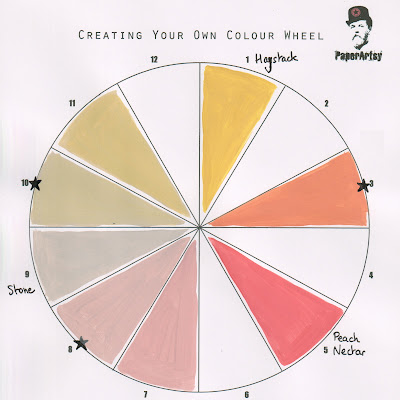
Orange - Neutral
Main Colour: Dirty Orange
Complements: Yellow Beige, Pink Stone
Type: Twist - One colour is neutral ( FF Stone)
Created from Frescos: Haystack, Peach Nectar, Stone


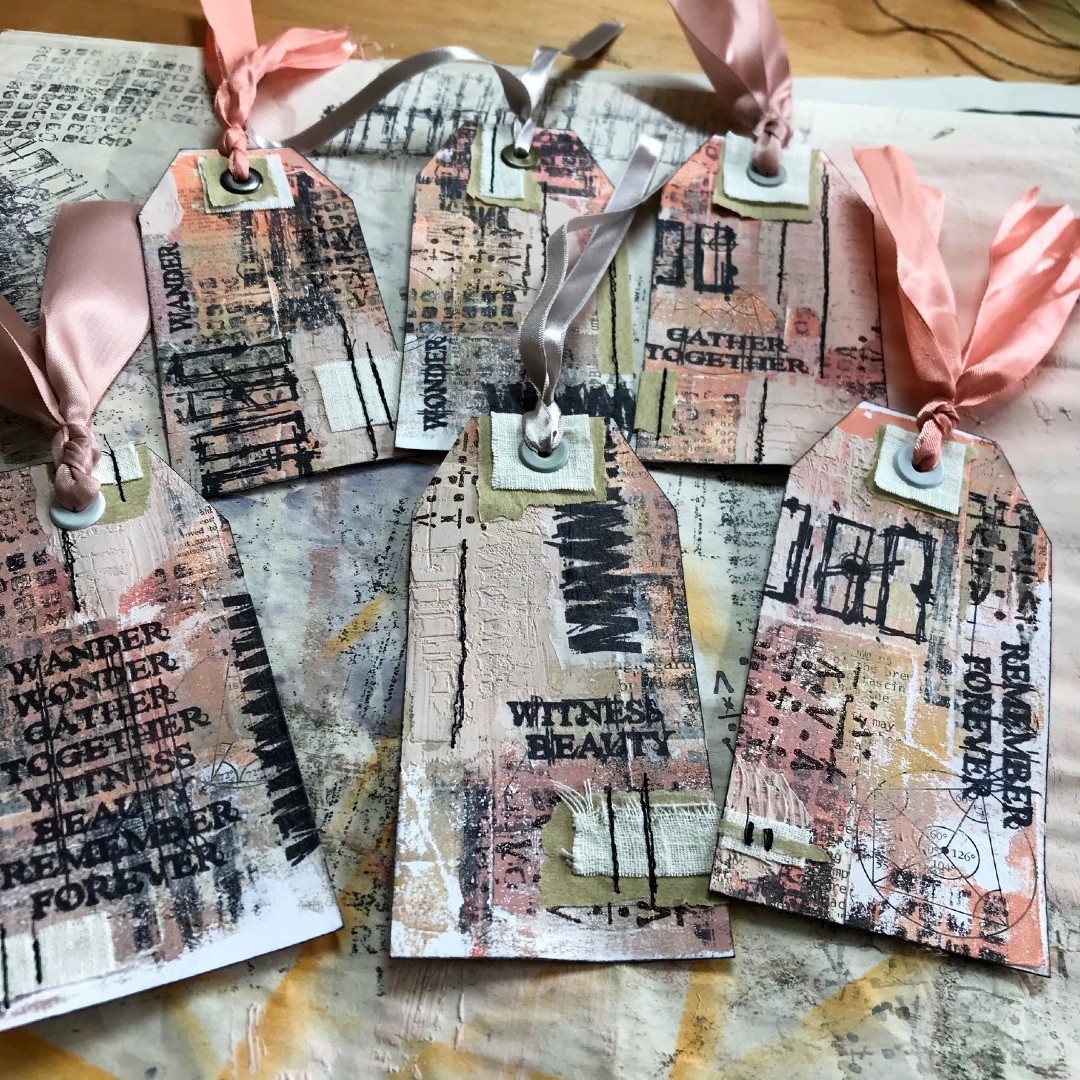
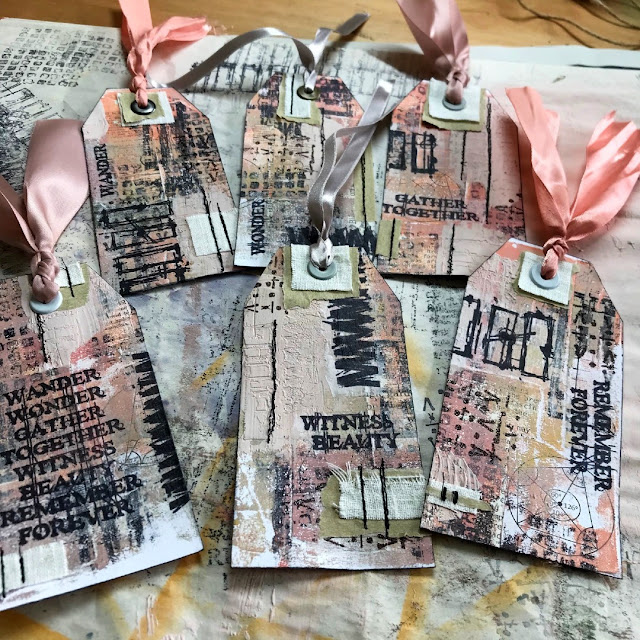
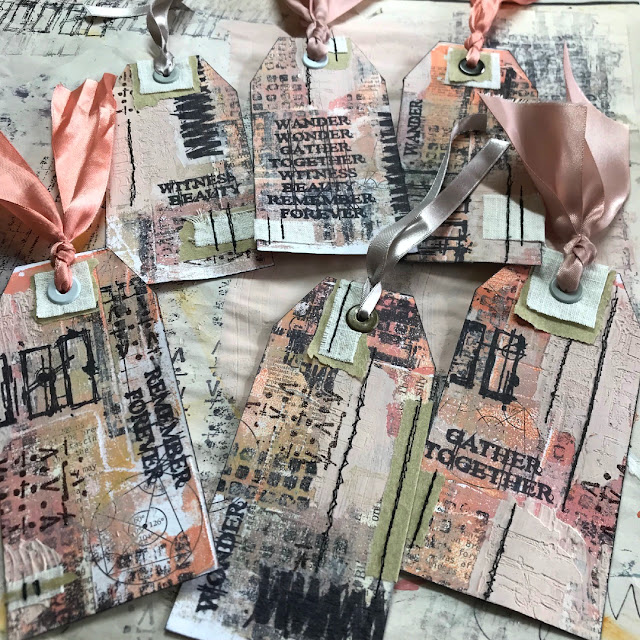
Hi everyone, it's Floss (flossworkshopart) with you today, and I'm here to share how I used layers to create a set of matching (but non matching) mixed media tags using split complementary colours with you.

How can they be matching but not matching at the same time I hear you cry...take a look below and you'll see that by creating a 'master board' first it naturally lends itself to become  an un-matching set.


I really love to incorporate texture, fabrics and collage within my art...mix that in with some stitching and embossing and it makes me one very happy girl. So when Seth Apter brought out his new range of mini stamps I was literally jumping for joy when they arrived in the post and I just could not wait to get into my workshop and start using them! 


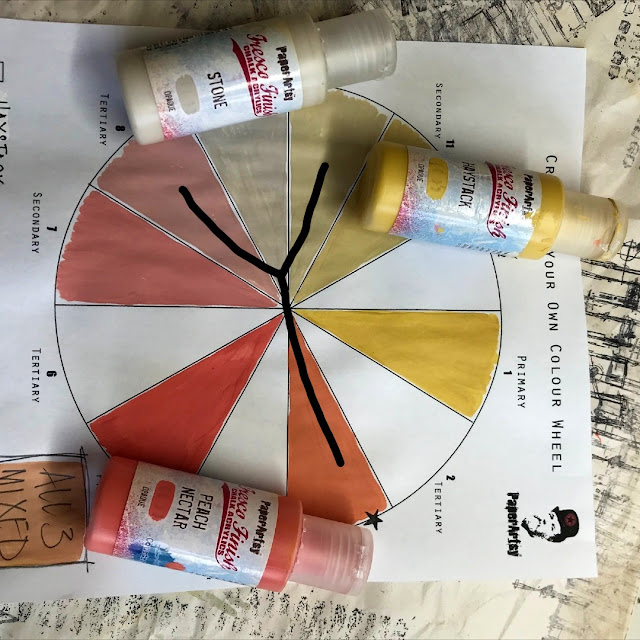
I started by creating a colour wheel with the beautiful HAYSTACKPEACH NECTAR and STONE fresco finish colours with the idea of layering these colours together to make a set of mixed media tags incorporating fabrics and eyelets. 

You can create your own colour wheel by using the PaperArtsy blank found at https://www.facebook.com/groups/paperartsypeople/files. I found this sheet particularly useful to check my colours throughout the making as I wanted to limit my palette to the three mixed colours and didn't want variation in my mixing.

Here comes the theory bit...if you need clarification to understand the split complementary colour process...or you missed Keren's introduction a few days ago...I hope you find my explanation clear...please do jump straight ahead to the next bit** if you already have a good understanding of what split complementary colours are. 

The position of a letter Y is helpful in finding which mix of paints you'll be using on the colour wheel. First of all mix equal amounts of your two chosen primary colours together to make your secondary colour.  In this case because it's a twist on the standard colour wheel I used Haystack and Peach Nectar to create my 'dirty orange' (secondary) shade seen on the down stroke of the Y. The complementary colour of the dirty orange is Stone. As it is 'split' complementary you'll be using the tertiary colours either side of the stone shown below with the two upper V strokes of the Y to create your art. You mix these tertiary colours which I will call pink stone and yellow beige by mixing equal amounts of the mixed secondary colours (Stone with Peach Nectar and then Stone with Haystack) with stone.

**Using the split complementary colour combination is a fun way to explore how colours really go together well. You'll notice there is a little box beneath the colour wheel with 'all 3 mixed' written inside it.  I often use a mix of all my colours that I use on one piece, I find it brings them all together and harmonises my art. I added this box as a force of habit without even thinking, however, I did not use this mix on the tag project this time as I wanted to stick to the three colours shown with the Y.


Prior to using my new colour palette I used some old book papers with different sized text and fonts, with some old maths papers to collage onto a sheet of 300gsm white card.  I like to collage different size/font style text over another as, for me, I'm not trying to read the text but use the it as a form of textured marks. I also like to rip rather than cut the pages as I prefer the raw look rather than a clinical/stark edged feel to my art.

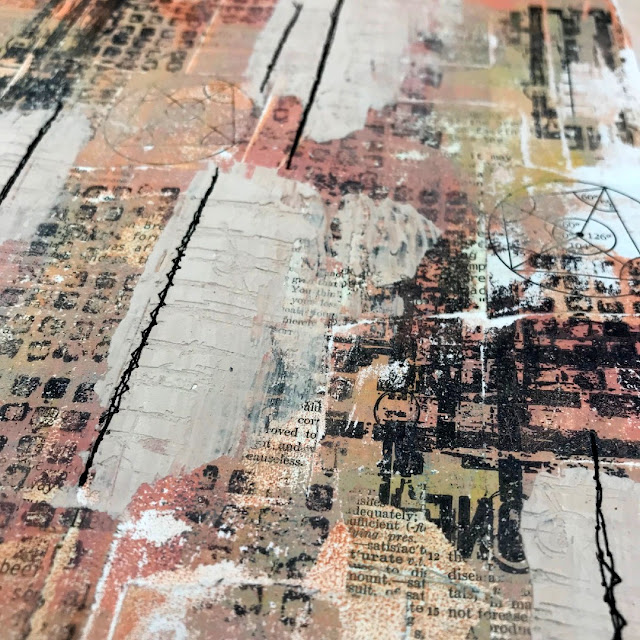
To begin building my coloured layers I used Ranger's black Archival ink with one of Seth Apter's gorgeous new rubber stamps (EM67 - available now from PaperArtsy Retailers) with an older one of my favourites EM41, to stamp some textures onto my 10 x 8 gel plate and let that dry. Remember what you put down first onto your gel plate will be on the top of the pulled print. 
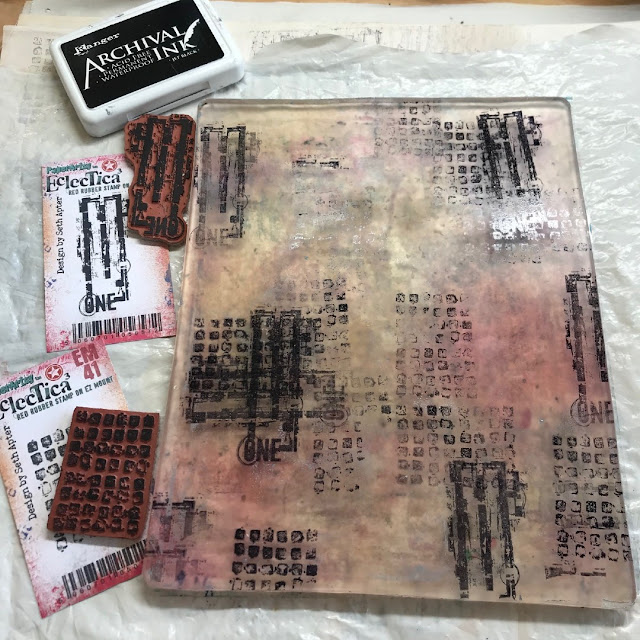
Notice how I have created + crosses by using the EM67 'ONE' stamp portrait and landscape over each other, and layered the 'ONE' stamp over the EM41 multi boxes stamp to make the texture my own...you may prefer to make x crosses. Seth did say "make it your own" in his introduction blog post...and that's what I love about these new mini stamps; they have so many options to truly go bonkers with a multitude of different textures in the way you use them, so do have some fun...Try using different pressures when applying the stamps to the gel plate or don't renew the ink each time you stamp to give you a variation on shades too. I started mixing my colours to use on the gel plate whilst the ink was drying. I found it useful to have the colour wheel to hand to check my mixing to keep the continuity in the colours.


I started with applying the lightest colour first, yellow beige, (made by mixing Haystack with Stone then  mixed with Stone again) and only covered parts of the plate. I didn't want to pull a flat colour print (which would have happened if I'd covered the whole plate) and left that to dry. I loved the way the paint 'pickled' a little leaving tiny bubble circles within the colour; I hoped the next shade would show through when I pulled it. I let this dry too.


I was actually itching to see how this was going to come out as the layers were looking so beautiful on the gel plate, and as you know, you never really know what that pull is going to be like when it comes off so I had my fingers crossed it would all be ok and I wouldn't have to re collage a sheet...although...the way I looked at it was that if it all did go wrong I'd just have a bit more play time...so that's not a bad thing!


I then used the pink stone colour, (made by mixing Peach Nectar with Stone then mixed with Stone again) and covered the remaining parts of the plate. Before pulling the print I used the EM41 and EM67 rubber stamps again, this time pressed into the paint to take areas of paint off and also stamp the paint elsewhere on the plate too. By doing this I am not only creating more texture but allowing different colours to show through the layers. I used the collaged sheet to pull the print.


Look at the way the edges of the collage have left fabulous marks on the gel plate ready for a fun second pull. Using collage on the pulled print not only leaves those edgy marks on the gel plate ready for the next pull but gives you interesting lines within the print where there are different levels of paper.


To add solid blocks of texture I mixed my 'rose stone' with some grunge paste and used a palette knife to spread a thin layer of this over parts of the now collaged printed card. I was aware that the colour was slightly lighter than the three I was trying to stick to, but gave myself permission to run with it as I wanted the solid grunge texture block. I then used EM70 to press the rectangle textures and EM72 zigzag textures into the grunge paste whilst it was still a little damp. If you try to do this whilst it is very wet it will give you a very smudged/stippled appearance rather than the clean lines of the stamp. Maybe do a test piece before you apply it to your master sheet if this process is new to you. If you need the image to be a little softer then wait for the grunge paste to dry and sand it back. By sanding it, it can also give you the option of some interesting high and low areas.

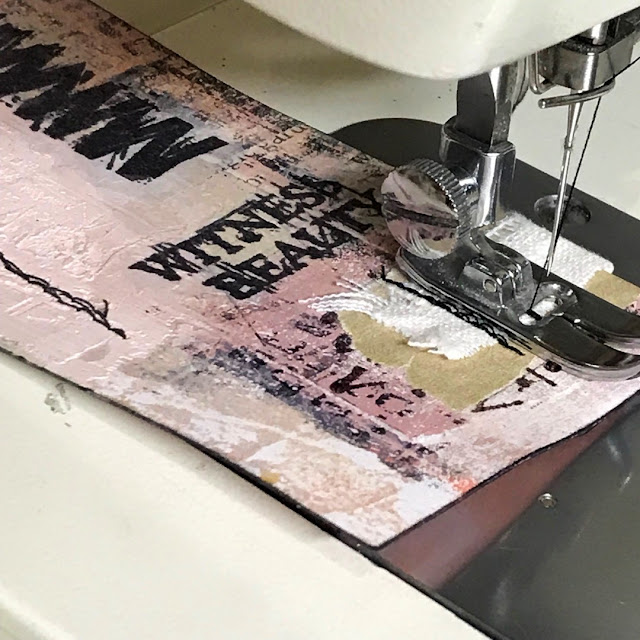
I ran the whole piece through the sewing machine using black thread for contrast. The lines of the collage and grunge paste gave me a hint of where to sew. I used six random lines as there would be six tags.  I made sure some of the lines crossed where the master sheet would be cut and so where each tag would be separated from one another. On the reverse, I put masking tape over the stitched lines. This was to secure the stitching ,especially where it would be cut mid line but also to add to the texture.
 

Rubber stamp EM69 just sang to me to be embossed using the new Mud Pie WOW embossing powder.  It has a very slight metallic shimmer to it but it's not too 'glitzy'. I am not a glittery sparkly kind of girl at all but I quite like a little metallic shimmer from time to time. I decided to use only a small section of the stamp so as it was not too overloaded and just gave it a slight accent.


I used a similar method for gel printing on the reverse but without stamping black ink onto the gel plate first. Instead I chose to use the stamp EM70 in the paint on the plate after I rolled it to give more stamp definition in the contrasting colours.


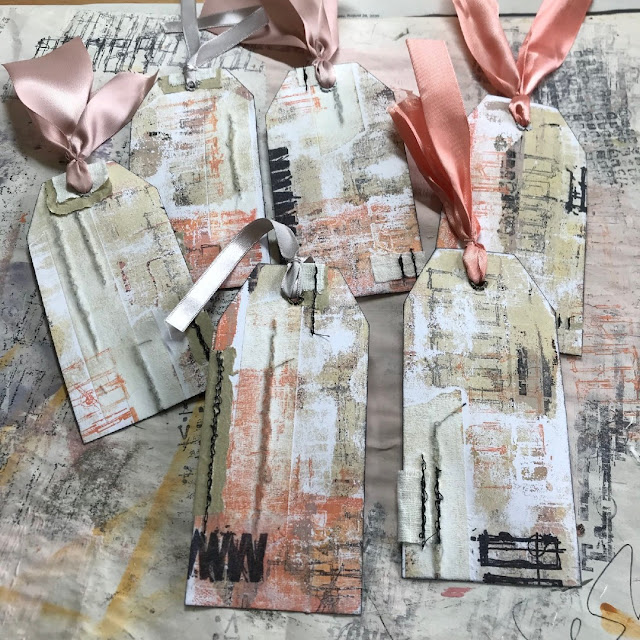
I then chose to divide the A4 sheet into six. The first cut was in half making two A5 sheets then each A5 into three so each piece measured 105mm x 70mm. You may choose to make your tags a different size...whatever works for you and what you will use them for...

I was happy with my colour swatching! The colour wheel really did prove helpful with mixing consistently! 

 
I like corners taken off as triangles so measured 16mm in from each edge along the top and 30mm down the sides and snipped them off using scissors. Once you have done one you don't really need to measure any others as you have made your template with the first one...measure twice cut once to be sure before you cut. You may prefer a rounded tag top or one that is cut using a scalloped punch.

I thought I'd use Seth's "more is more" approach as I was using his stamps so stamped a few acid free white tissue paper sheets with EM41EM66, EM69, EM70 and EM72 and collaged these tissue paper bits over the sewn tags using a matte medium.


To make the tags more sturdy where the ribbon is attached I decided to use remnants of natural linen and bits of old parcel paper where the eyelets were to be punched. I tore the paper to have a fairly rugged edge using a deckled edge ruler and rough cut the linen remnants. You may prefer to cut the paper rather than tear it, especially if you cut your collage right at the start to match that.

I machine stitched some of the added linen and parcel papers for more textured detail again using black thread. I often use a combination of straight and zigzag stitching over one line.


Again I used the colour wheel to swatch/colour match my ribbon/threads. I could not believe my luck in that I actually had a very near match to the 'dirty orange', 'pink stone' and the 'yellow beige' in ribbons that I collect from odds and ends.


Thread and tie your ribbons/threads through the eyelets, if you chose to use them and enjoy what you have achieved.


The reverse being a little less detailed allows space for you to add messages, quotes, phrases, words of kindness or whatever you choose to add...or not.


I thoroughly enjoyed making these tags and the gel print pull for me was both exciting and nerve wracking at the same time with the not knowing if it would work. I definitely had an ohhh yesss!!! moment when I revealed the amazing textures that the collaged lines had left behind as well as added to the pull. Its definitely a technique I will use again. Let me know in the comments below if this is something you have already done or if you are eager to try it. 

I love the way these colours work together and painting the colour wheel has proved to be a good step to use if you are unsure of your colour mixing/matching choices. I personally can see a pile of these growing in my workshop as I explore more combinations.  

I think looking at the tags now I may even go back to them and add some hand stitches over the zigzag stamped prints or some of the other lines, but I will look at them for a while first before I make that final decision...If you are more of an ATC kind of person maybe this technique may inspire your next batch?

Until next time, enjoy your art time and I'll see you again soon... 

Much love
Floss 🌸


If you live near me (East Sussex UK) and fancy joining me doing this project in my workshop then I will be holding in-person classes of up to six persons over the next few coming weeks. You can find a link to this and all my other mixed media workshops on my website at  www.flossworkshopart.com